Beyond the Headlines: Iran

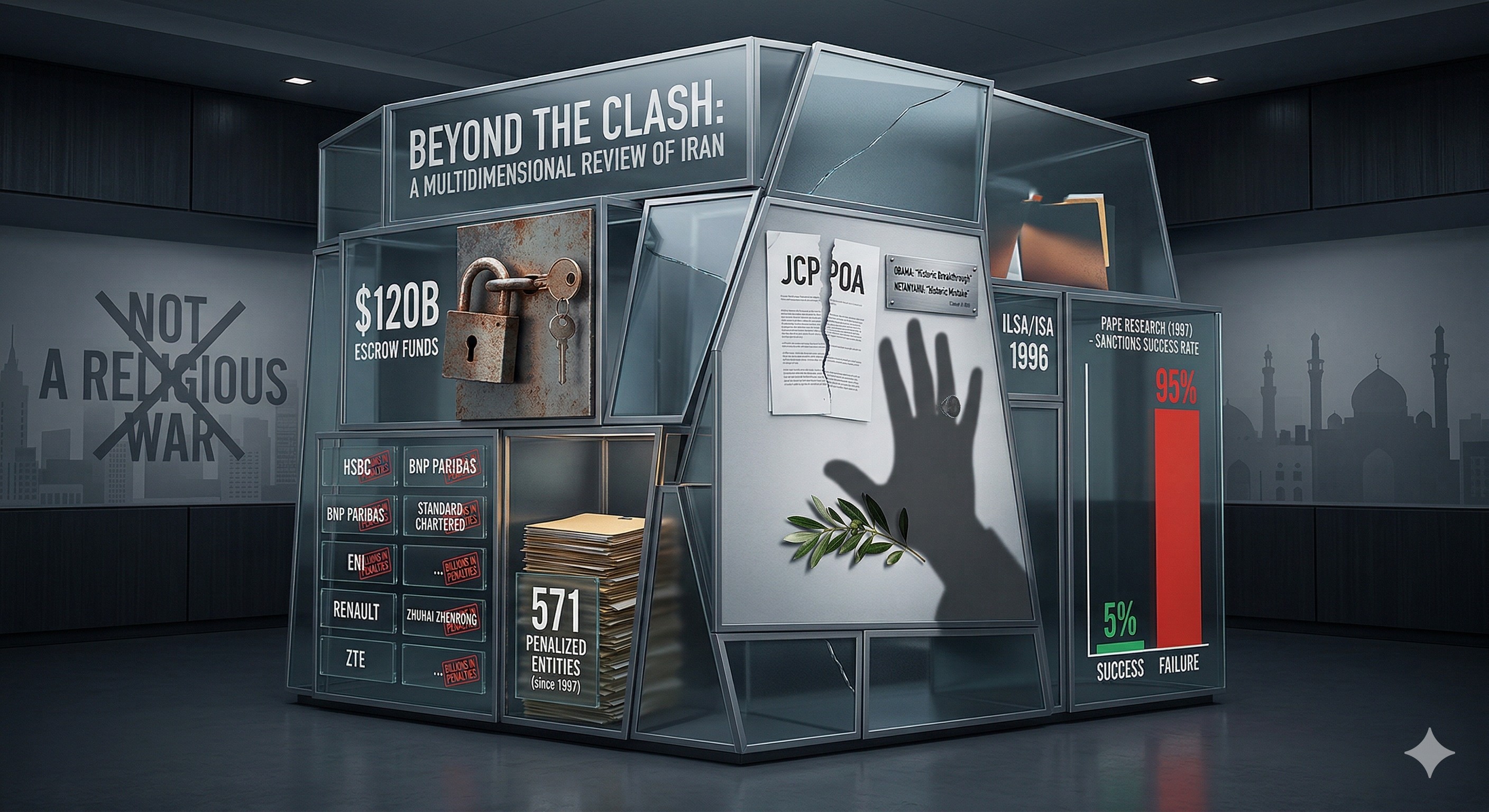
Most of us have a narrow view of the Iran issue, i.e., this is some religious war, Islam vs the West. I do not ask you to change your view; I also ask you to consider the following facts. The Iran issue has multiple dimensions, and I’ll try to keep a very long story short. So excuse me if details are missed.
Firstly, we know the Americans, Europeans, ME, Israel do not want Iran to build nuclear capability or to funnel petrodollars to organizations like Hezbollah (not going into the details, we all know). To curb this, the US has been imposing secondary sanctions on Iran under the ILSA (Iran and Libya Sanctions Act 1996), later renamed the ISA (Iran Sanctions Act), because primary sanctions have not worked. In his seminal research article, ‘Why Economic Sanctions Do Not Work’ (1997), Roger Pape studies economic sanctions levied between 1914 and 1990 and concludes that only 5% have been successful. On the other hand, military force has generally been more effective. This paper is available on Google Scholar, and I suggest reading it.
Secondly, under the JCPOA (2015), Iran and the P5+1 agreed to exchange Iran's nuclear programme for relief from sanctions (Obama-Rouhani/Javad Zarif). This was considered a major milestone and a solution to the issue. Iran wants its $120 Bn that is stuck in escrow accounts due to sanctions to be repaid. Iranians at the time had a $200 Bn hole in their coffers. Obama called the JCPOA a ‘historic diplomatic breakthrough while Netanyahu declared this a ‘historic mistake.
Thirdly, post-JCPOA, America could not convince concerned parties and banks to release the funds to Iran, as many of them had previously been penalised in billions of dollars for violating sanctions including HSBC (UK), BNP Paribas (France), Eni (Italy), Renault (France), Zhuhai Zhenrong Corp (China), ZTE (China), Unicredit (Italy), Standard Chartered Bank (UK). A total of 571 companies and individuals have been penalized since 1997. This meant three things.
- Iran could not guarantee the rollback of their nuclear program
- The USA would have to pay back about $20 bn+ taken in penalties, which they did not want to accept.
- Iran could not get access to the global financial markets. I think so far Iran has received only $4 Bn of the $120 Bn owed.
See https://www.unitedagainstnucleariran.com/violations-penalty-tracker for all the companies and individuals that have been fined.
Then comes Trump, who ripped the JCPOA and has taken the military approach to the Iran issue, definitely at the behest of Israel.
Comments (0)