Are Parents Always Right, Even When They Are Unjust?
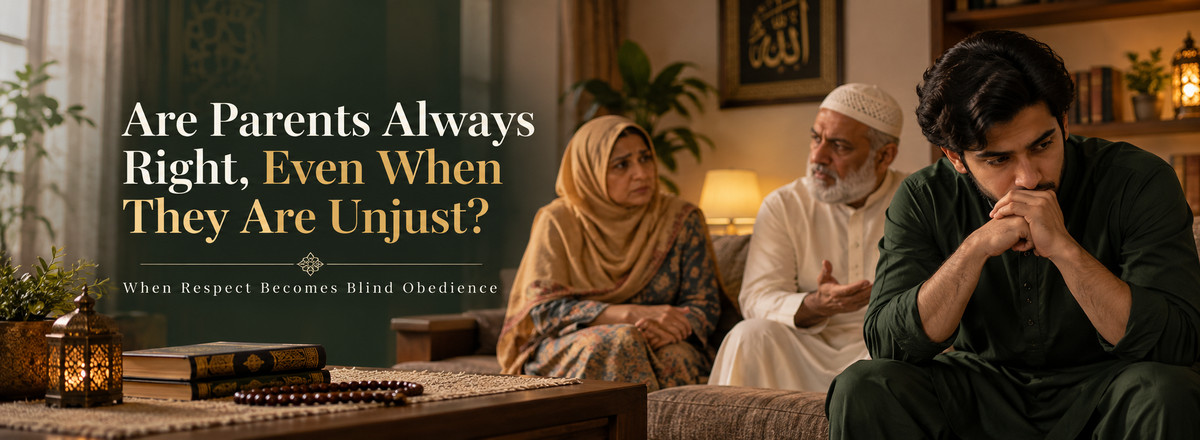
Islam teaches respect for parents, but does it demand blind obedience? Explore how the Quran and Hadith distinguish parental rights from cultural traditions and why justice must come before unquestioning obedience.
When Respect Becomes Blind Obedience: An Islamic Perspective on South Asian Family Culture
In many South Asian Muslim households, there is one sentence that can end almost any discussion:
"They are your parents. They can never be wrong."
A son questions an unfair family decision and is called disobedient. A daughter refuses a marriage proposal and is accused of disrespecting her parents. A married son tries to protect his wife's rights and is reminded that paradise lies beneath his mother's feet. A daughter asks for her rightful inheritance and is told that good daughters never question their fathers or brothers.
The discussion ends before anyone asks whether the parents' decision was actually right.
But here is a question we rarely dare to ask:
Did Islam teach us that parents are always right, or did our culture turn respect for parents into unquestionable authority?
This question is not about encouraging children to disrespect their parents. Islam leaves no doubt about the honour and respect owed to them. The real question is whether that honour gives parents the right to make unjust decisions without being questioned.
And surprisingly, the Quran answers this question more clearly than many of us realize.
When Allah Commands You Not to Obey Your Parents
One of the most remarkable verses concerning parents appears in Surah Luqman:
وَإِن جَاهَدَاكَ عَلَىٰ أَن تُشْرِكَ بِي مَا لَيْسَ لَكَ بِهِ عِلْمٌ فَلَا تُطِعْهُمَا وَصَاحِبْهُمَا فِي الدُّنْيَا مَعْرُوفًا
"If they strive to make you associate with Me that of which you have no knowledge, do not obey them, but accompany them in this world with appropriate kindness."
Quran, Surah Luqman (31:15)
Consider the significance of this verse.
Allah presents an extreme situation in which parents pressure their child toward shirk, one of the gravest sins in Islam. Yet even in this situation, the Quran does not permit obedience to their wrongful demand.
At the same time, Allah commands the child to continue treating them kindly.
Two principles are established together: parents deserve kindness, but their authority is not absolute.
If parental authority has limits even in this extraordinary situation, how can we reasonably claim that every parental decision about marriage, finances, family relationships, or personal choices must be accepted without question?
This verse does not mean children may reject any instruction simply because they dislike it. Rather, it establishes that parental obedience operates within moral and religious boundaries.
Islam commands respect for parents. It does not declare them incapable of making mistakes.
The Difference Between Respect and Obedience
Somewhere in our social upbringing, we have confused two entirely different concepts: respect and obedience.
Respect means recognizing someone's dignity, speaking to them kindly, appreciating their sacrifices, and fulfilling their legitimate rights.
Obedience means following someone's instructions.
These two concepts may frequently go together, but they are not identical.
You can respectfully disagree with your father. You can love your mother without accepting an unjust demand. You can appreciate your parents' sacrifices while recognizing that their understanding of a particular situation may be mistaken.
The Prophet Muhammad ﷺ established a principle concerning obedience:
إِنَّمَا الطَّاعَةُ فِي الْمَعْرُوفِ
"Obedience is required only in what is good."
Sahih al-Bukhari, Hadith 7145
The Hadith originally concerns obedience to an appointed commander, but it establishes a broader principle that obedience is not unconditional.
This is especially significant in societies where children are sometimes taught that disagreeing with elders is itself a moral failure.
But disagreement and disrespect are not the same thing.
A respectful disagreement may be entirely justified. An insulting agreement, made with resentment and contempt, may be morally worse.
We should teach children how to disagree respectfully rather than teaching them never to disagree.
When Parents Become Unjust
Imagine a father who decides that his daughter's inheritance should remain with her brothers because family property must stay with the sons.
His daughter knows that Allah has granted her inheritance rights. But when she raises the matter, her father becomes angry.
"After everything I have done for you, you are questioning me over money?"
Now the daughter faces a difficult choice.
If she remains silent, an injustice may continue. If she speaks, she risks being called ungrateful.
Many families would advise her to remain silent out of respect for her father.
But what does the Quran say?
يَا أَيُّهَا الَّذِينَ آمَنُوا كُونُوا قَوَّامِينَ بِالْقِسْطِ شُهَدَاءَ لِلَّهِ وَلَوْ عَلَىٰ أَنفُسِكُمْ أَوِ الْوَالِدَيْنِ وَالْأَقْرَبِينَ
"O you who have believed, be persistently standing firm in justice, witnesses for Allah, even if it be against yourselves or parents and relatives."
Quran, Surah An-Nisa (4:135)
This verse directly challenges the idea that family loyalty must always come before justice.
Allah specifically mentions parents among those against whom a believer may be required to stand for truth.
That does not permit children to insult or humiliate their parents. But it does mean that the relationship itself cannot justify dishonesty or injustice.
A parent may be deeply loved and still be wrong.
A child may be deeply respectful and still have a legitimate complaint.
When family loyalty demands that we ignore injustice, we must ask whether we are protecting our parents or merely protecting their mistakes.
The Emotional Burden of "We Sacrificed Everything for You"
There is another deeply rooted practice in many South Asian households.
Whenever an adult child makes a decision that parents dislike, the conversation sometimes turns toward sacrifice.
"We raised you."
"We paid for your education."
"We gave up our happiness for you."
"Is this how you repay us?"
These sacrifices are real and deserve gratitude. Raising children requires extraordinary patience, financial commitment, and emotional effort. Islam recognizes these sacrifices, particularly those of mothers.
But should parental sacrifices become a permanent debt that children can repay only by surrendering every personal decision?
Consider a son who wants to pursue a different career from the one his parents have chosen.
Or a daughter who wishes to marry a suitable person but faces opposition based solely on social status or biradari.
Or a married couple seeking separate accommodation because constant family interference is damaging their marriage.
These situations require careful consideration of rights, responsibilities, circumstances, and Islamic rulings. Not every disagreement means the parents are unjust, and not every personal preference creates a religious entitlement.
However, the statement "We are your parents" cannot automatically settle every dispute.
Gratitude should not become a means of emotional control.
Parents deserve lifelong gratitude, but gratitude does not require surrendering one's conscience.
Are We Protecting Parents or Protecting Their Mistakes?
An especially important Hadith challenges the way we understand loyalty.
The Prophet Muhammad ﷺ instructed Muslims to help their brother whether he was being oppressed or was an oppressor.
The companions asked how they could help someone who was committing oppression.
The Prophet ﷺ explained that they should prevent him from oppressing others.
Sahih al-Bukhari, Hadith 2444
Think about the implication for family relationships.
If a father is treating one child unjustly, is supporting him without question truly an act of love?
If a mother continually mistreats her daughter-in-law, does a son honour his mother by refusing to acknowledge the problem?
If parents are pressuring one child to sacrifice legitimate rights for the benefit of another, should the rest of the family remain silent merely to preserve harmony?
The Hadith teaches that genuine support does not always mean agreement.
Sometimes helping someone means preventing them from doing wrong.
This is not an invitation for children to appoint themselves judges over every parental disagreement. Rather, it reminds us that wrongdoing does not become right simply because the person committing it is someone we love.
If we truly care about our parents and their accountability before Allah, should we encourage their mistakes or help them recognize those mistakes with wisdom and respect?
What About the Quranic Command Not to Say "Uff"?
At this point, someone will understandably raise an important objection.
Does the Quran not prohibit even a small expression of irritation toward parents?
Yes, it does.
Allah says:
فَلَا تَقُل لَّهُمَا أُفٍّ وَلَا تَنْهَرْهُمَا وَقُل لَّهُمَا قَوْلًا كَرِيمًا
"Say not to them [so much as] 'uff,' and do not repel them but speak to them a noble word."
Quran, Surah Al-Isra (17:23)
This command must never be ignored.
But notice what the verse regulates: our treatment of our parents.
It commands dignity, kindness, and respectful speech. It does not establish that every opinion expressed by a parent is correct.
Surah Luqman gives us the balance. Even when parents demand something religiously unacceptable, a child must refuse that demand while continuing to treat them kindly.
One verse teaches us the manner of disagreement. The other establishes that disagreement may sometimes be necessary.
The two are not contradictory.
Together, they teach something more demanding than either blind obedience or careless rebellion.
Stand for what is right without abandoning good character.
The Fear of Being Called Disobedient
In some South Asian families, the word nafarmaan (disobedient) carries enormous emotional weight.
A child may be called disobedient for choosing a different profession, questioning an unfair financial arrangement, refusing an unsuitable marriage, or requesting reasonable boundaries.
Of course, some children genuinely behave disrespectfully. Some neglect their parents, speak harshly, or place personal convenience above genuine parental needs.
Such conduct should not be excused.
But equally, parents should not use religious language to turn every disagreement into a moral accusation.
There is a difference between a child saying, "I do not care what happens to you," and saying, "I respect you, but I cannot agree with this decision."
The first may reflect neglect or cruelty. The second may reflect an honest difference of judgment.
Neither parents nor children should assume that their own wishes are automatically right.
The Quran holds everyone accountable.
Parenthood deserves honour, but it does not grant moral infallibility.
Parents Are Human Too
Perhaps the most difficult thing for some families to accept is also the simplest.
Parents are human beings.
They can be loving and mistaken.
They can be experienced and misinformed.
They can sincerely desire their children's happiness while making decisions that harm them.
They may also carry fears and assumptions inherited from their own upbringing.
A father who grew up believing that his family's reputation depends on controlling his children's choices may repeat the same pattern without questioning it.
A mother who endured difficult treatment from her in-laws may unconsciously expect her daughter-in-law to endure the same.
Sometimes what we call tradition is simply an old injustice passed from one generation to another.
But suffering through something does not make it right to impose it on someone else.
We should honour our parents' sacrifices without turning every practice they inherited into a religious obligation.
And parents, too, can demonstrate tremendous strength by acknowledging mistakes.
Imagine a father telling his son, "I made this decision believing it was right, but perhaps I was mistaken."
Or a mother telling her daughter, "I did not understand how my words affected you. I am sorry."
Would such admissions reduce their dignity?
Or would they teach their children something far more valuable than unquestioning obedience?
A Lesson from Asma bint Abi Bakr
An incident from the life of Asma bint Abi Bakr (may Allah be pleased with her) helps us understand how Islam separates religious conviction from family affection.
Her mother, who was not Muslim at the time, came to visit her.
Asma asked the Prophet Muhammad ﷺ whether she should maintain relations with her mother.
The Prophet ﷺ instructed her to maintain those ties.
Sahih al-Bukhari, Hadith 3183
The lesson is significant.
Islam did not require Asma to abandon her religious convictions to maintain her relationship with her mother. Nor did it require her to abandon her mother because of their religious differences.
She could maintain her principles while continuing to fulfil the duties of kinship.
This provides an important model for difficult family disagreements.
Holding a different position does not necessarily mean rejecting a relationship.
Can Parents Also Be Accountable to Their Children?
We regularly remind children of their duties toward parents.
We quote verses about parental rights, discuss the importance of serving parents in old age, and warn against disrespect.
All of these teachings matter.
But how frequently do we remind parents that they also carry responsibilities?
That children are not possessions?
That fairness between children matters?
That marriage and family decisions involve rights beyond parental preferences?
That anger does not automatically establish authority?
That financial dependence should not become a licence for humiliation?
Islamic family ethics cannot be understood by discussing the rights of one party while ignoring the responsibilities of the other.
A healthy family does not function like a courtroom where parents are always the judges and children are permanently the accused.
It requires mutual accountability, even though the roles and obligations of parents and children are not identical.
Parents should guide rather than dominate.
Children should respect rather than blindly surrender their judgment.
Both should be willing to recognize mistakes.
The Real Meaning of Honouring Parents
We should be careful not to replace one extreme with another.
Rejecting blind obedience does not mean encouraging children to become selfish or dismissive.
Parents often have wisdom that younger people lack. Their warnings may come from experiences their children have not yet encountered. Sometimes the child is wrong, and the parent is right.
But wisdom should be considered, not assumed to be infallible merely because of age or relationship.
A mature child listens carefully, examines the matter honestly, seeks sound advice when necessary, and communicates respectfully.
When parents make a reasonable request, fulfilling it may be an expression of love and religious duty.
When their request involves disobedience to Allah, it must not be followed.
When the issue concerns a lawful personal decision, the relevant rights, obligations, and circumstances must be examined rather than assuming either absolute parental control or unlimited individual freedom.
And when there is genuine injustice or harm, the answer may require respectful boundaries, mediation, or protection rather than passive submission.
Honouring parents is a lifelong responsibility.
But it should never be confused with declaring that they cannot be wrong.
Conclusion: Are We Teaching Respect or Fear?
Perhaps we should reconsider what kind of families we are building.
Do we want children who speak honestly to their parents, or children who hide their feelings because disagreement is forbidden?
Do we want parents who guide through wisdom, or parents whose decisions cannot be questioned?
Do we want family unity based on love and justice, or silence maintained through guilt and fear?
Islam places parents in a position of extraordinary honour. That honour should never be diminished.
But Islam also establishes principles of justice, personal accountability, and moral responsibility that apply to everyone.
A father does not stop being a father when he makes a mistake.
A mother does not lose her dignity when her child respectfully disagrees with her.
And a child does not automatically become disobedient simply because they refuse something unjust.
We can disagree with our parents without dishonouring them. We can recognize their mistakes without forgetting their sacrifices. We can protect our rights without neglecting theirs.
Perhaps the question we should ask is not whether parents are always right.
Perhaps it is whether we have confused honouring our parents with treating them as though they can never be wrong.
Because ultimately, Islam teaches us to honour our parents, but our highest loyalty remains to Allah and His justice.
Parents deserve our respect, our gratitude, and our kindness. But being a parent does not place anyone above the truth.
Quranic references: Surah Luqman 31:15; Surah An-Nisa 4:135; Surah Al-Isra 17:23.
Hadith references: Sahih al-Bukhari 7145, 2444, and 3183.
Comments (0)