Our 3D World
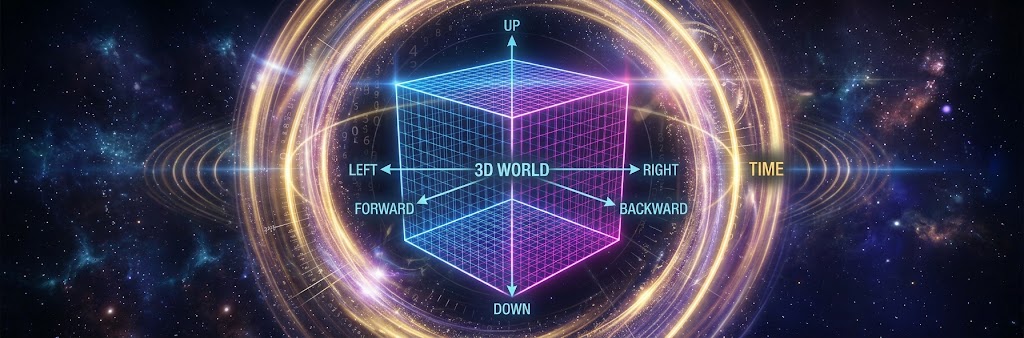
Dimensions are length, breadth, and height, and Allah has placed human beings within them. In the first dimension, we can move forward and backward. In the second, we can move left and right. In the third, up and down. This is our 3D world. Around it runs a boundary line: the fou…
Dimensions: Our 3D World
The World We See, and Where Our Sight Ends:
What are these dimensions? The idea of a three-dimensional world fascinates all of us. Today I will try to explain it in the simplest language I can.
Dimensions are a world of length, breadth and height, and Allah has placed human beings inside it. In the first dimension, we can move forward and backward. In the second, left and right. In the third, up and down. This is our 3D world. Around it runs a boundary line: the fourth dimension, which is time. Time keeps us from stepping outside our three-dimensional world.
But the story does not end there. Our vision has a boundary line too. In the world we live in, light travels in waves, and this is called the electromagnetic spectrum. It holds seven kinds of light, and the human eye can see only one of them: visible light, which sits between ultraviolet and infrared. Of the whole spectrum, we see only a tiny sliver, commonly quoted as about 0.0035 percent.
To understand how limited our sight is, I would like to quote a hadith. Abu Hurairah (may Allah be pleased with him) reported that the Prophet (peace be upon him) said: "When you hear a rooster crow, ask Allah for His bounty, for it has seen an angel. And when you hear a donkey bray, seek refuge in Allah from Satan, for it has seen a devil." [1]
Roosters mostly crow around Fajr, and another hadith tells us that the angels who come to us by night and by day meet at Fajr and Asr, and change their shifts. [2] Now look at the rooster's eye. A human eye has three kinds of colour-sensing cells, called cones; a rooster's has four. That is why it can see ultraviolet light, which is invisible to us. It sees roughly from 315 to 750 nanometres, while we see from 400 to 750. Its field of vision is about 300 degrees, ours about 180, so it also catches fast-moving things that slip past us. So it may be that angels appear to a rooster in the ultraviolet range. And Allah knows best.
Allah has kept a great deal hidden from our eyes: unseen beings like the jinn and the angels, and tiny things like microorganisms, so that we may live in peace. If our own sight is this limited, imagine what may lie beyond our world.
Angels, Heavens and Time:
Science has some theories about dimensions that reach far beyond our three. Superstring theory speaks of 10, M-theory of 11, F-theory of 12, and bosonic string theory of 26. These are theories, not proven facts.
Many people believe the angels are free of time. I do not think so. Time is itself a creation of Allah, and whatever is created lives within some realm of time. The angels may be free of the time of our 3D world, but they are bound by another.
One narration in Jami' at-Tirmidhi tells us that the Prophet (peace be upon him) asked his companions, "Do you know what is above you?" He then told them that between us and the first heaven is a journey of five hundred years, and so it goes through seven heavens, each separated by the same distance, with the Throne above them all. Below us, he said, lie seven earths, also five hundred years apart. At the end he recited verse 3 of Surah Al-Hadid. Imam Tirmidhi explains the hadith as pointing to Allah's knowledge, power and authority, which are everywhere. [3] Another narration, reported by Al-Abbas ibn Abdul Muttalib, gives the distance as 71, 72 or 73 years. [4] (A word of caution: scholars of hadith have graded both narrations as weak, so I offer them not as conclusive proof, but as a pointer.)
Whatever the case, if we live in a 3D world, who knows how many unknown dimensions the angels live in? Allah alone knows. But even their dimensions must have a limit of time. Every creation that is to die has its appointed hour written in the Preserved Tablet, so it must be held within time. And a creature bound by time must ask permission to pass from one dimension of time into another. On the Night of Mi'raj we see exactly this: when the Prophet (peace be upon him) and Jibreel (peace be upon him) reached the first heaven, Jibreel asked its gatekeeper to open the door, and was asked who he was and whether the Prophet had been called. [5] So the angels pass through these doors. The Quran also speaks of the doors of heaven:
"And the heaven will be opened, and it will become gateways." (An-Naba 78:19) This speaks of the Day of Judgment.
"Those who deny Our signs and turn away from them in arrogance, the gates of heaven will not be opened for them, nor will they enter Paradise." (Al-A'raf 7:40)
Time may run at a different pace in these heavens and earths. Only our Lord, Glorified and Exalted, is free of time. He is the Lord of the Throne, from where all decrees go forth. About the Lote Tree of the Furthest Boundary, Sidrat al-Muntaha, a hadith tells us that when something from Allah's command covered it, it was transformed, and no creature of Allah could describe its beauty. [6] Another narration says that what rises from the earth reaches that point, and what descends from above is received there. [7]
The Donkey, the Jinn and the Souls:
Let me return to the hadith we began with, and its second half: when you hear a donkey bray, seek refuge in Allah from the accursed Satan, for it has seen him. What is it about a donkey's eyes that lets it see what we cannot?
Research tells us that the retina holds two kinds of light-sensing cells, cones and rods, millions of them. Cones help us see in daylight and in colour; rods help in dim light and at night. A donkey's eye is far better made than ours for seeing in the dark, so it can pick out things at night that escape us. A donkey brays when it is happy, lonely or bored, but the hadith tells us that sometimes it brays because it has seen Satan.
Here is another interesting thing: donkeys do not see the world as we do. We have three kinds of cones, sensitive to red, green and blue, so our vision is called trichromatic. Theirs is dichromatic, with only two kinds of cones, so they mostly pick out blues and greens. Have you ever noticed that in cartoons and films, the world of the jinn and devils is often drawn in green and blue? That is only my guess, not a proven fact. Perhaps those colours are simply a human picture, a visual metaphor, because the true nature of the jinn is known to Allah alone.
The jinn were created from fire. Devils are one kind of them, and among the jinn there are both believers and unbelievers. Since the jinn are not today's subject, that much introduction will do.
Now let us talk about souls. After death, a human soul goes to the realm of Barzakh, and we get a glimpse of it in the hadith of Mi'raj. When the Prophet (peace be upon him) reached the first heaven, he found Adam (peace be upon him) there. When Adam looked to his right, he smiled; when he looked to his left, he wept. The Prophet asked Jibreel about this, and Jibreel said that on Adam's right and left were the souls of his children: on the right, the people of Paradise; on the left, the people of Hell. That is why he smiled at one side and wept at the other. [5] The full reality of Barzakh, and where it lies, Allah alone knows best.
All complete and perfect knowledge belongs to Allah alone, Glorified and Exalted. Indeed.
رَبِّ ھَبْ لِیْ حُکْمًا وَّاَلْ حِقْنِیْ بِالصّٰلِحِیْنَ وَاجْعَلْ لِّیْ لِسَانَ صِدْقٍ فِی الْاٰخِرِیْنَ وَاجْعَلْنِیْ مِنْ وَّرَثَۃِ جَنَّۃِ النَّعِیْمِ
"My Lord, grant me wisdom, and join me with the righteous. Grant me a truthful name among later generations, and make me one of the inheritors of the Garden of Bliss." (Ash-Shu'ara 26:83–85)
Author: Khadija Tayyab
Hadith References:
[1] Sahih al-Bukhari 3303; Sahih Muslim 2729 (Abu Hurairah)
[2] Sahih al-Bukhari 555; Sahih Muslim 632 (Abu Hurairah)
[3] Jami' at-Tirmidhi 3298 (Abu Hurairah)
[4] Jami' at-Tirmidhi 3320; Sunan Abi Dawud 4723; Sunan Ibn Majah 193 (Al-Abbas ibn Abdul Muttalib)
[5] Sahih al-Bukhari 349; Sahih Muslim 163 (Abu Dharr, from the Mi'raj narration)
[6] Sahih Muslim 162 (Anas ibn Malik)
[7] Sahih Muslim 173 (Abdullah ibn Mas'ud)
Note: Every reference has been checked with care, but human error is possible. If you spot a mistake, please tell me, and I will correct it.
Comments (0)